Archive for May, 2007
Educators For NonViolence (EFNV) – Michael Nagler
by sky on May.31, 2007, under Audio Interviews, Making organizations work, Media, Peace and ethics
Educators For NonViolence [EFNV.ORG] is a group of educators operating under the auspices of the Metta Center for Nonviolence Education. It was co-founded by The Dalai Lama Foundation a couple of years ago.
EFNV is holding its second summer teacher conference on Friday and Saturday, 20-21 July, 2007 on the University of California campus in Berkeley CA.
The coordinator of Metta Center’s volunteers as well as coordinator of the planning activities for the EFNV conference is Jordan Pearlstein at the Metta Center.
Michael Nagler is founder of the Peace Studies program at Berkeley, and leader of EFNV. I had a Skype conversation this morning with him where we discussed the conference and the organizations.
| Click to open audio player: |
Audio clip: Adobe Flash Player (version 9 or above) is required to play this audio clip. Download the latest version here. You also need to have JavaScript enabled in your browser. |
. . . . . . . . . . .
Links we promised during the interview:
- EFNV.ORG and its conference page
- The Metta Center for Nonviolence Education
- Michael Nagler’s UC Berkeley courses PACS164A & PACS164B for web viewing and podcast download
- Eknath Easwaran
- Rachel McNair
- Dr. Joseph Marshall – Omega Boys Club
- Azim Khamisa – The Tariq Khamisa Foundation
- Jack Duvall – A Force More Powerful
Galaxies of “Fundamental Questions”
by sky on May.30, 2007, under Learning and eLearning
Buddhist science[1] spends a lot of time on why external reality[2] is in essence a delusion. And modern physics, psychology and brain science also struggles with questions such as whether the brain creates consciousness (or rather, whether consciousness is the activity or even just a side-effect of the brain’s activity). And self-consciousness may or may not be separable from perception.
I spent some time this morning reading edge.org – where, once a year, a whole lot of thoughtful people, each of whom is also well-known in their field of practice, are asked to give their answers to some fundamental question. I was reading the 2005 question, which I found had sparked a bunch of interesting reactions.
And yesterday I spent some time discussing DroppingKnowledge.org with a friend. The premise of Dropping Knowledge is to have brought together 112 individuals from around the world, with diverse backgrounds, to answer 100 important questions. Most of the questions were about the future of the world, the individual and society. All 11,200 “answers,” at three minutes each, were captured on video and are searchable and playable online. It’s a fascinating experiment.
“If You Liked This, You’ll Like That…”
by sky on May.26, 2007, under Blogging, Software and online tools
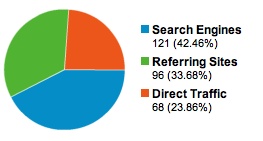
If you got to my blog via a Google, Yahoo, or (Microsoft) Live search, then you’re actually in the minority, but these days that’s how zillions of people find absolutely everything when they’re online. It’s what I call the I-forgot-the-name-of-that-site-but-I‘ll-just-bring-up-Google-and-search strategy. Over the past couple of years, specialized search engines that are focused solely on blogs have risen in prominence — and the one I pay most attention to is Technorati. Google also “knows about” blogs and your blog “places higher” in Google searches if it has lots of connections from other blogs. But, there are other such blog-search nexuses as well.
Here’s what I want to point out. The conventional wisdom from 1995 to maybe 2003, was that a web site had to keep its visitors “on the site” and never give them a chance to leave. A visitor who went off to another site was equivalent to a lost sale. So web sites jealously guarded their links and seldom contained “offsite” links (those whose targets are outside the web site). The sites that did contain “links pages” (meaning pages of reciprocal links with other web sites) were primarily those of individuals — and search engines like Yahoo.
Now today, in the blogosphere, it’s become an accepted belief that people who search for information about “X” would be interested in reading about “X” no matter whose blog it’s in. So if you’ve searched for “Dalai Lama” and gotten to my blog, the assumption is that you’d like to read other blogs that mention the “Dalai Lama.” How is that accomplished? And is it even good for me, as a blog-writer, to facilitate your going off to read other blogs?
Future Leaders for Peace – Jonathan Kathrein
by sky on May.24, 2007, under Audio Interviews, Learning and eLearning, Making organizations work, Peace and ethics
I sat down in a coffee shop in Berkeley (CA USA) a week ago with Jonathan Kathrein, the founder of Future Leaders for Peace.
FLFP conducts workshops in schools – from grade-school thru college – their workshop lasts 90 minutes, including a video, to capture attention and inspire; it starts with interviews of people the kids can relate to, from sports figures to real people, and continues to Jonathan sharing his stories, including the shark attack he survived at Stinson Beach in 1998; proceeding to then get the kids to share their own stories in small groups of 8 or so – their challenges and conflicts and experiences. To paraphrase Jonathan – It’s amazing how similar their challenges are and yet each one thinks they’re unique – by sharing, they learn how to better approach and overcome adversity in their lives.
| Click to open the audio player: |
Audio clip: Adobe Flash Player (version 9 or above) is required to play this audio clip. Download the latest version here. You also need to have JavaScript enabled in your browser. |
Jonathan has also written a children’s book Don’t Fear the Shark – a story of his shark attack, but one in which the shark is a bully mistreating humans because it has been mistreated itself – the story looks at how the cycle of violence arises and can be prevented. As he says, the story ends abruptly and the reader has to figure out how it would or could end.
Jonathan is also a hard-working member of the organizing committee for Educators For NonViolence.
[posted with ecto]

I hope you’ll enjoy this mix of topics stemming from my ongoing experiences in the world of online communication. Oh, and sometimes the inspiration comes from face-to-face communications too. Many were sparked by my work as Chief Technology Officer of