In the land of the blind, the one-eyed man is king.
The surgery took about 10 minutes. I pretty much remember the whole process and it was very interesting. At its conclusion they covered my eye with a dressing, which remained the first 24 hours. My first impression was that my eyelashes were kinda stuck and my eyes wanted to open and close together even though the surgeruzed eye felt scratchy due to the dressing and tape. The doctor later told me he expected my eyelid to stay closed, so if something wasn’t quite working as intended, but there seems to have been no ill effect.
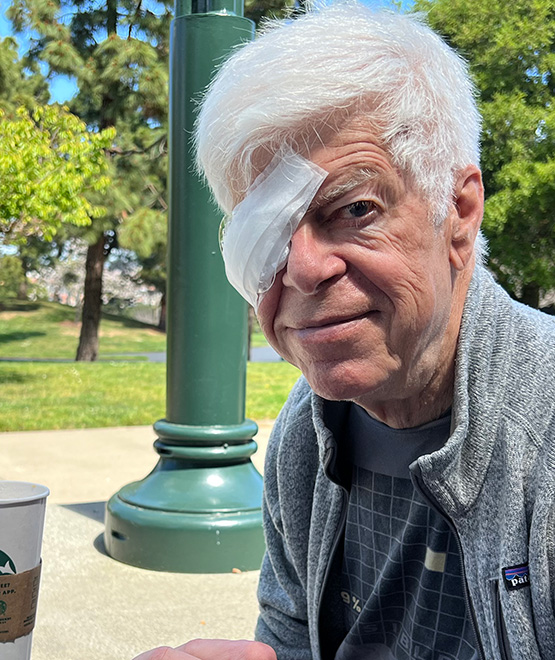 Many people say those first 24 hours are really difficult. I found that being mentally “prepared” helped a lot. I just had to be really, really patient and resist any temptation to scratch or pull on the dressing to make it more comfortable.
When my eyelid was open, I could tell there was plenty of light and I could see areas of dark and light thru the dressing – corresponding to what my natural (left) eye was seeing. So it was pretty exciting to know everything worked but no hint yet about clarity of vision.
Let’s call that Day Zero.
Day 1
Next morning I visited the doctor to have then dressing removed and a quick check-up. Sitting in a eye-exam chair with a chart on the far wall, they removed the bandage. It was absolutely astoundingly clear and sharp. I knew immediately this was going to be a good result — maybe an excellent result. The letters on the eye chart were mostly sharp, and I could confidently read down to the 20/30 line. My understanding was that this is pretty good for the first post-surgery day. I found that reflective objects like chrome on the equipment was “delightfully sharp” and sparkly. It was obvious the lens was going to be excellent!
To rest my eyes prior to surgery I had had a pair of glasses made. (I previously wore contacts, not glasses.) But now with an IOL in my right eye those glasses were not going to work for me. So I went to an optometrist who knocked out one prescription lens and replaced it with regular glass. This barely worked, leaving me with dpuble vision (although it was sharp), but was going to only be temporary anyway.
Week 1
During daytime hours I wore the modified glasses at times, but rapidly discovered it was more restful to just leave them off and let the natural eye be extremely blurry — because my vision with the IOL was so good I could do almost any daily activity confidently. At night I wore a transparent plastic eyepatch taped on, to prevent scratching and injuring the eye.
I decided not to drive until both eyes were completed. Good decision.
The trifocal aspect of the IOL was fascinating, and brain adaptation kicked in by about Day 2 or so. I noticed immediately that the best vision was distance vision. This became spectacularly obvois as night fell. From our windows in San Francisco we see a lot of the city as well as distant San Francisco Bay and the Marin and the East Bay hills.
As the sun set on about the second day, I realized I clearly saw every distant window in Salesforce Tower, and even better I saw the decorative lights of the Bay Bridge. On the East Bay hills, about 15 miles away, I could see individual tall trees on that ridge. I was not seeing those with my natural eye and the glasses. The IOL was at times sharper than my natural eye.
The IOL slightly reduces optical contrast, and that was initially obvious to me, though it was only bothersome when I attempted to read grey type against a white background. I would say it was tolerable. This was also more noticeable at night and with low light levels. It did get better as I approached the end of the week. My guess would be that I was adapting to the light curve of the lens.
But by about the 4th day I could already tell that the IOL did not cause me any problem with glare, halos, or rays, around most bright lights at night. This was super exciting because it is one of the more common outcomes for many people, and I had problems only with the most super-bright lights (like a car headlight coming at me on a city street).
The trifocal aspects of this IOL began to become useful by Day 6. I found I could easily focus on a laptop screen and use the computer for a few hours without strain. Couldn’t use both eyes together, but the single IOL eye, as long as I stayed relaxed and didn’t attempt actively to focus, just kind of naturally was working.
I did not have much near vision, however, in that first week. It appears to me that relaxing and letting the eye and brain do their adaptation without straining, may be the trick.