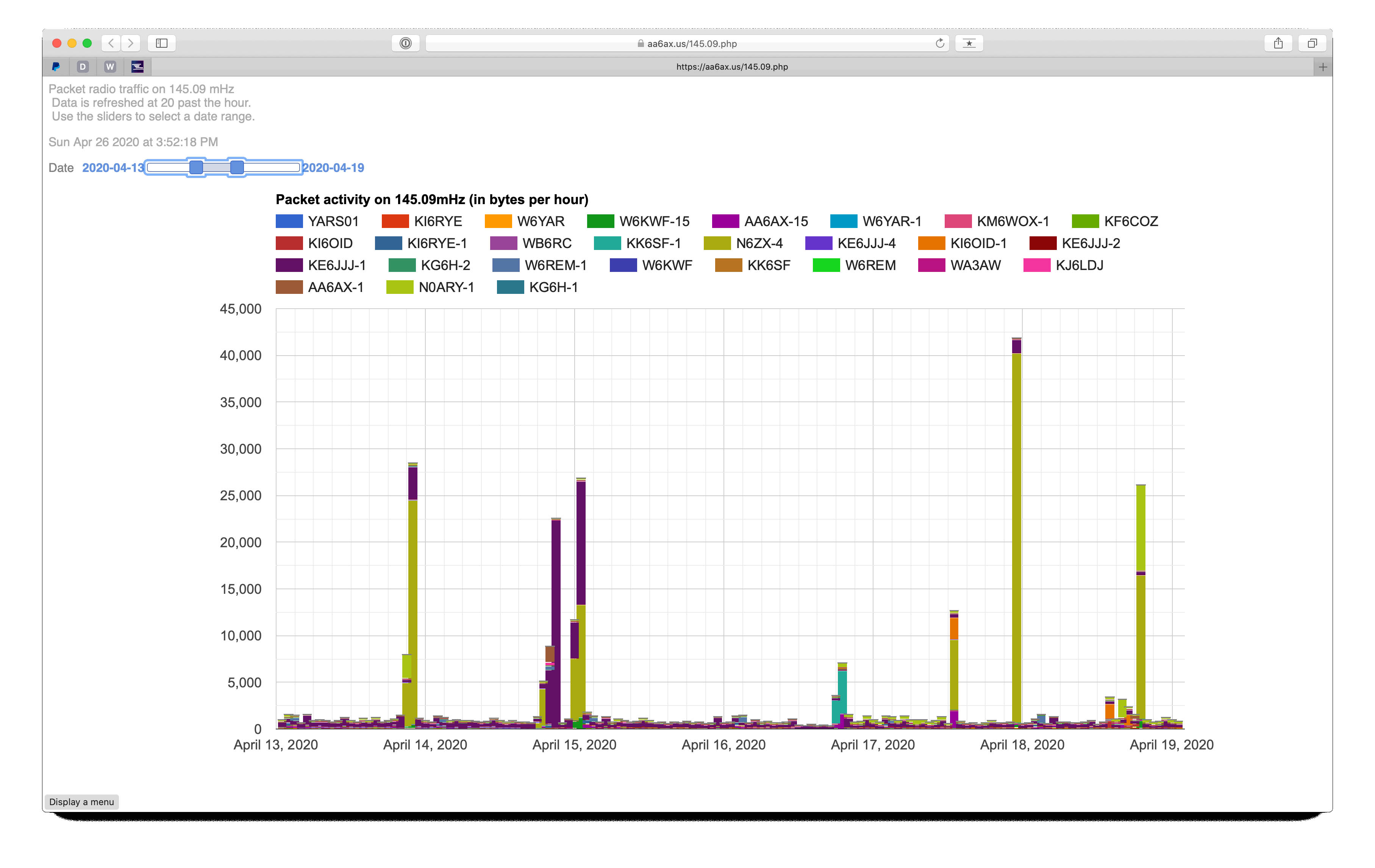
 Very techie here… For a few months I’ve been operating a packet radio station on a 2-meter radio frequency here in the San Francisco Bay Area. I explored what it would take to make this a full “BBS” (like an online “forum”), and then backed off and let it just hang around n this frequency listening to the other (mostly BBS) stations. A few days ago, I got interested in graphing the data to better understand what stations were using the frequency and when.
The chart is made by this process:
- JNOS (the software that runs the packet radio station) logs all data it hears on the radio;
- A Python script analyzes this log file, keeping track of what stations were heard in each hour;
- The Python creates javascript data in a form acceptable to Google Charts;
- The javascript is transferred to a web server;
- PHP code reads the javascript and inserts it in an HTML page;
- Google Charts javascript fashions the data into the interactive chart.
A “cron” job carries out this process once each hour to keep the chart data current. Because each data bucket spans a whole hour, there’s no need to update more than once an hour.
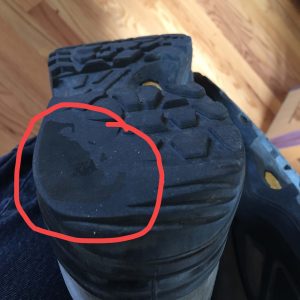 This is the fourth exactly-same-model of hiking boot I’ve worn over the last 10 or so years. A pair lasts two or three years — hundreds of trail and sidewalk miles. Then wears through, or the bottom sole begins to delaminate. Noticed today, as I purchased another pair, that the current pair is worn through on the heel’s outer side. So I roll my foot outward, or push outward, as I walk. The rubber nubby layer has been completely worn away and the basal layer below that is beginning to wear through. The previous pair was in tatters, with the soles almost flapping off, when replaced a couple of years ago.
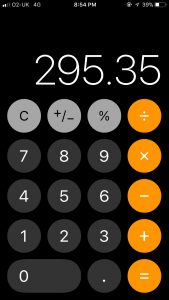 I traveled from Brussels to London on Eurostar this week. 295kph. Very much like other fast trains in Europe, and still exhilarating. Didn’t hit 300 on this trip, but always looking forward to that milestone.
 For years I’ve kept snippets of code in a file that I refer to when I need a cookbook of sorts to perform some magic incantation I only need to invoke once or twice a year. I just don’t need to keep this kind of stuff in my head. I call the file Gems of Wisdom.
 I like to think I’m open and helpful. Not everyone would agree. But the one thing that really annoys me is the email whose title is “…quick question…”