Sustainability
To… eliminate people as a cost to the economic engine
by Sky on Feb.03, 2010, under Frothy Concepts, Sustainability
I just read a blog post by Douglass Carmichael (who I’ve known through MediaX and NextNow events for a short while, and will spend some time with this weekend) entitled Governance and economy.
The thread of his post struck me smack in the face:
Economy has become so powerful because, in the absence of the political ideas to reform government to deal with the real issues of the world, economy emerges as a way to cope with 6 billion people…
Economy has become a form of governance…
The result is a way of life based on dollars and what dollars can buy, which is not so much meaningful goods but stuff…
The result is that we do not really have a governance of society. We have a governance of the society via economy and a governance of economics through the narrow interests of its major participants…
The well being of the people has been replaced by the well being of the economy, which, to make the rich yet richer, has chosen to eliminate people as a cost to the economic engine.
—Douglass Carmichael [excerpted by Sky from Governance and economy]
For 10 years now I have wondered how we expect to both 1) reduce jobs in the US and 2) maintain a functioning economy. I so much want to see people everywhere in the world achieve a good standard of living, and I know that we in the US need to reduce the way we squander our resources, but I don’t see how we can keep eliminating people from the economic engine and expect to have a sustainable economy, let alone a sustainable world. The gears of economy need to function differently—and I firmly believe that the turmoil we see in economic systems right now signals that we will never return to “normal” but instead will have to wrestle with these kinds of questions, and solve these kinds of problems, in order to stabilize our economic and social systems.
Read
The Solar Outhouse
by Sky on Apr.08, 2009, under Sustainability
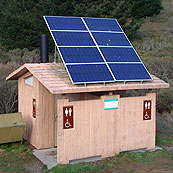
Solar cells on an outhouse? Yup. In the coastal headlands of Marin County.
We see these in the Sierras (the mountains) as well, in some high-traffic publicly-accessible areas of the wilderness. Usually the solar cells in the mountains are powering fans that circulate air into a composting toilet (one that composts the deposits rather than requiring removal to another location). And they’re generally so far from civilization that running a power line would be ludicrous.
But it always seems funny to me.
EDoS [Economic Denial of Sustainability] attacks
by Sky on Jan.26, 2009, under Security, Software and online tools, Sustainability
A Denial of Service (DoS) attack is one in which a server or service is “overwhelmed” by traffic and consequently either disabled or made unavailable to its customers. Typically the effect on the target of a DoS attack is a loss of business, or in the less critical cases, just failure to get his/her message out.
However, cloud computing allows us to scale our servers up and up in order to service greater numbers of requests for service. This opens a new avenue of approach for attackers, which originally was labeled an Economic Denial of Sustainability attack by Christofer Hoff (November 2008), with a follow-up just recently. (I was introduced to the concept by Reuven Cohen’s description published just today.)
In short, if your cloud-based service is designed to scale up automatically (which some like Amazon EC2 are), then an attacker can grief you economically by sending a huge number of (automated) requests that appear on the surface to be legitimate, but are actually fake. Your costs will rise as you scale up, using more and/or larger servers (automatically) to service those fake requests. Ultimately you will reach a point where your costs overtake your ability to pay – a point at which your economic sustainability becomes questionable.
Ouch!
[The EDoS concept applies primarily to cloud-based services and not to people who own their own servers, because if you own your own servers and are the target of a DoS attack, you don't immediately and automatically scale your operation up to a larger size, so the attack doesn’t immediately cost you money. It’s only when the scaling-up is automated and there’s no ceiling that you run the risk of economic damage.]
“The Other” $100 Laptops
by Sky on May.21, 2007, under Learning and eLearning, OLPC [$100 computer], Sustainability
Techmeme tracks news all over the web, and a link on Techmeme today to a BBC article brought to my attention yet another inexpensive laptop computer for kids. Intel has a $200+ laptop (the “$100 laptop” is now close to $175) that could also be in the running.
And let’s not ignore other efforts to create inexpensive computers, like Simputer and the recent announcement that India seeks to create a $10 laptop computer. (That’s, of course, going to be extremely difficult, but it does show that $100 may still be too high a price to achieve “everywhere” penetration.)
On CBS News, Lesley Stahl interviewed Nick Negroponte about the computer. There’s video there to be viewed. This is the CBS-OLPC institutional view, of course, but the discussion about OLPC in the blogosphere has gotten so negative lately that some positivity is welcome!
One Laptop Per Child
The Intel Classmate
- Google video of the first prototype of the Intel Eduwise computer (later the Classmate) at trade show (May 2006)
- C|Net article on Intel’s Classmate
- Brazil to test…Classmate
- A technical comparison of the OLPC “XO” and the Intel Classmate
- Wikipedia entry on the Intel Classmate
The Simputer (Simple Computer)
- Wikipedia entry on the Simputer
- Simputer web site
-posted using Ecto
I hope you'll enjoy this mix of topics stemming from my ongoing experiences in the world of online communication. Oh, and sometimes the inspiration comes from face-to-face communications too. Many are sparked by my work as Chief Technology Officer of