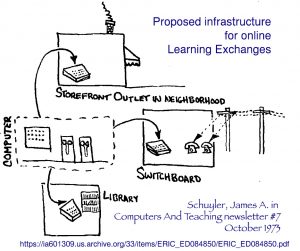
 In the 1970s, as a part of my Computers And Teaching [CAT] project, I had a lot of conversations about how computers might transform learning, communication, and social interactions.
I’ve already remarked on some predictions I made in 1973, including working from home, email, co-working spaces and online community access to information and learning. There were a lot of people working on these concepts in the 1970s. Many people had these and similar ideas, and much of the work presaged today’s online educational and social media. My personal focus was on communication in education, and my work involved using a supercomputer (and later a minicomputer) as a hub for education and distance-independent group communication.
Notable among those I interacted with
Community computing—People’s Computing Company (Bob Albrecht) in Menlo Park. Resource One (Lee Felsenstein) on Howard in San Francisco. Whole Earth Store (Rich Green) in Evanston (and Berkeley).
Computer conferencing—Murray Turoff (New Jersey Institute of Technology and formerly the Office of Emergency Preparedness). NSF project managers.
Networks—Doug Engelbart and team (Stanford Research Institute, SRI). I was at Doug’s lab he day they connected to the “Arpanet.”
(There’s a whole additional thread of people who worked in computer-based-education, which I’ll write up later.)
Resource One
[from PDF Online Computer Conference 1973 ]
This is Lee Felsenstein of Resource One speaking. This is our first attempt at using the ORACLE system (What did that OK mean?). We will be participating using our XD3-940 timesharing system. We hope to make the conference A) (IND of sub-conference here, since we will be able to accommodate several people building comment files on our editor program and shipping these comments off post-haste during our connect time. Likewise we will be able to accumulate files of comments from Evanston and will print these upon our high-speed printers so that participants here may read and absorb at less than 30CPS. We are inviting several people from alternative education circles. We also hope to stir up enough interest in local people so that they will be interested in starting a Bay Area learning exchange, hopefully using our machine and its information-retrieval system (ROGIRS). We have been operating a version of this system as a public-access database in a record store lobby in Berkeley for over a hundred days, letting just plain folks come up and use it like an electronic bulletin board. It works! People smile as they are told that it’s a computer at their service, we have accumulated about 700 items on the database so far (Items expire too, so there’ve been many more entered in toto).
You search for your item by telling the computer to find all items satisfying a particular combination of keywords which you specify. Keywords are determined solely by the person who enters an item and can be any string of characters. The terminal tells the user how many items have turned up satisfying a given keyword set. Example FIND RIDE EAST (Note: ‘and’ is implied by no connecting word between keywords);
13 ITEMS FOUND (This is the response from the machine). AND NEW YORK OR NY (this is the user narrowing these – actually a mistake has been made here, the machine will add to the list of items having keywords RIDE, EAST, NEW, YORK, the sum the items having keyword NY, anyhow enough detail). The user types ‘PRINTALL’ or ‘PRINT:’ if they want to seal off the found items or just the first one respectively. The user may add an item at any time. There is no preset field structure or limited set of keywords the system can print. An alphabetized list of keywords currently in use at any time. This list is kept by the Berkeley terminal. We think that this system can be used as is for filing in a learning exchange. It is important to note that the system makes no judgements, but is simply a very talented file clerk that doesn’t keep you waiting. We are ready to offer terminals into system to local users who can participate in paying our costs. (We are nonprofit, the machine and a startup grant were donations, but operating money is not assured.)
We will be refining the information retrieval system and hope to be able to move it off future (equipment costs $50,010 for system serving 64 simultaneous users and capable of storing several million items XXX whoops, that would be about 100-200,000 items at 200 average characters per item) and will be eager and able to manufacture such systems which require no daily maintenance. Why not have everything?
Our address is 1380 Howard St., San Francisco CA, 94103, and our phone is xxxxx. Off for now.
 I was recently reviewing the seven newsletters of the Computers And Teaching [CAT] project. I previously commented on an article that predicted the
  I just reviewed the seven archived newsletters of my Computers And Teaching [CAT] project, written in 1972 and 1973. During that time I led other graduate students, faculty and staff at Northwestern University and the Vogelback Computing Center (a big centralized supercomputer facility) in promoting online educational uses of the computer. There was no network to speak of in those days…computers were just beginning to be able to “dial up” and chat with each other, and the computer terminal was still remarkably new. I was a new faculty member, having just completed a PhD in Computer Science, and my mentors were
 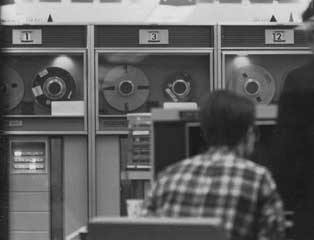 I was alerted to the presence online of a transcript of an “online computer conference” I organized in late 1973 when I was a professor at Northwestern University, and running my project called Computers And Teaching [CAT]. Murray Turoff, who was with the (US) Office of Emergency Preparedness had been running conferences limited to government participants, and Bob Johansen (while a graduate student) and I got the idea of doing a conference that would combine physical presence and remote presence, which we held in November, 1973. The PLATO-IV system, of course, had included its own internal online conferencing (serving maybe a couple thousand people at the time), but that was limited to people with PLATO terminals. Our goal was to expand conferencing well beyond that group by using an interactive system I had built.
 I just discovered, due to some exploration by