
Until recently, Google provided a pretty straightforward “Sitesearch” service that any webmaster could use as a “local site search engine.” Pretty simple to configure and use – I did one for a private client of mine a month ago, and it took about half an hour to configure and then install on their web site. And SiteSearch provided a Search box that permitted your site visitors to search just your site or to search the entire web – their choice.
But it’s now gotten more complex. And it’s gotten much better.
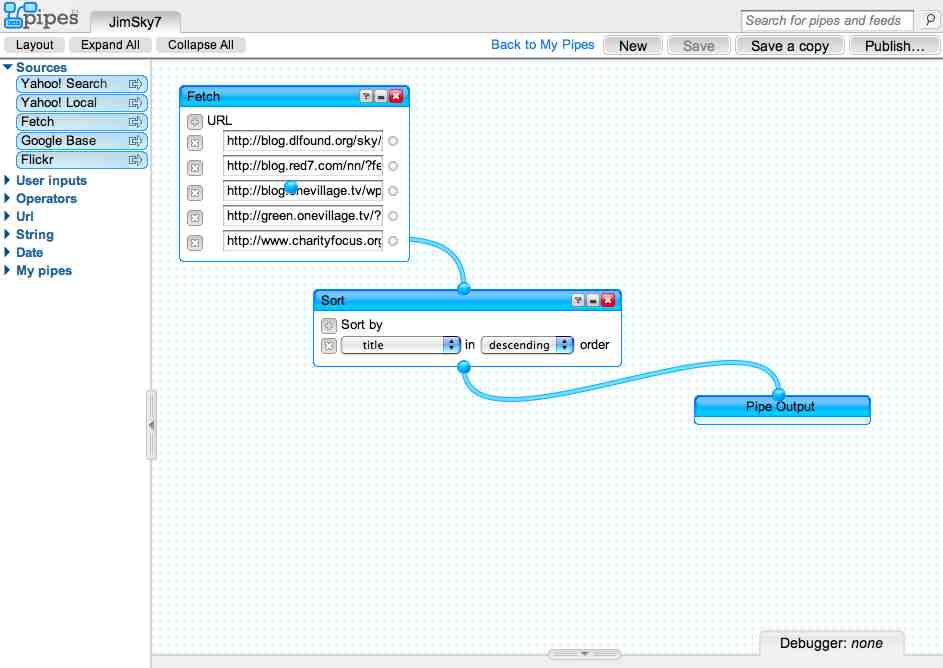
Yahoo “Pipes” – a service that mashes RSS feeds
I’ve been looking for this like the holy grail for
about a year now, and it’s not really in production yet, but I can see that it will rapidly become very popular. Yahoo has introduced a new service, Yahoo Pipes, that allows us to visually select and combine any number of blog RSS feeds, filter their contents, sort them, and then output those combined feeds as a single feed. This combined feed can then be used by anybody for any purpose. (Well, the terms of service may restrict it to non-commercial, so read them carefully.)
I’ve already been doing much of my real-time feed-reading and mashing using some Gecko Tribe products by Antone Roundy. CaRP and Grouper are the products I’ve been using. And Feedburner also does some of what Pipes does. But these tools don’t really allow me to intermix the feeds in chronological order. So that’s where, in my opinion, Pipes will really excel.
Yahoo Pipes provides an easy-to-use on-screen visual interface that can be used to easily combine feed sources and juggle them to product a nicely-mashed output feed. [read on…]
When is FREE “Stable enough?”
Following up on my post about the decision whether to use free software or not, this MacWorld article Blogger bugs bug bloggers- Bloggers frustrated by Blogger bugs, Google says it will get better describes the woes of those using Blogger’s free online hosting following a recent upgrade of the software. It’s upsetting to base any portion of your business on a service and have it come crashing down, but probably even more upsetting if you base it on a free service like Blogger and then have it come crashing down.
Google/Blogger says the problem affect relatively few people, but there are obviously many people who use the service as part of their commercial activities, and these people are in real deep trouble.
I avoid this by hosting my blogs on servers that I own, and I only upgrade software after making a trial installation or two and I test it at least a few days if not a week before I deploy it to other sites. (I maintain 15 WordPress sites at the moment and have two servers in operation, so this isn’t the solution for everybody.)
Overview of blogging tools
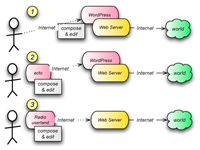
To help conceptualize where the “rubber meets the road” when it comes to creating your blog – and help you sort out the blogging tools that I’ve been discussing in the last few posts, I put together some diagrams.
These diagrams and their explanations may help you understand the three methods I’ve been discussing for posting to your blog…
The “Other way” to blog – Radio Userland & iWeb
I don’t want to short-change one of the inventors of blogging (or at least of RSS), and a software industry veteran, Dave Winer, and his Radio Userland.

This application, Radio, was one of, if not the first, pieces of software that allowed the creation of a weblog right from your computer. A later program that I’ve used that does the same thing is Apple’s iWeb. Each of these programs lets you create pages and then uploads them to a web server – there’s no additional software required on the web server, unlike the three offline blogging tools I’ve covered recently, Flock, ecto and MarsEdit.
But Radio and iWeb stand the model “on its head” compared to the way WordPress and Blogger work. Who would use them? [read more…]
[Read more…]
- « Previous Page
- 1
- …
- 34
- 35
- 36
- 37
- 38
- …
- 46
- Next Page »