 I laughed out loud at the opening “paragraphs” of The Queen’s Christmas Day Speech 2017, which I viewed today. She opens with some comments on technology – she was first on television 60 years ago, and she has lived through an amazing transformation in communication (due to computers). I am beginning to understand the “time machine” aspect of being that old (she is 91) — as she has viewed so many changes and developments. These speeches are certainly written by others — such trendy statements, and the interleaved video, unlike so many presidential addresses with the man-behind-the-desk vibe we know so well. I found it all to be a reminder of the age of the British Empire, yet fresh with hints of how Britain and London have really moved into the modern connected world. And you could see expressions on her face clearly indicating that she understood well the unique modern import of what she was saying, as well as a funny pause where certainly there must have been thoughts and words going through her head like “gads…what is this about?…gulp.”
Community Computing in the 1970s
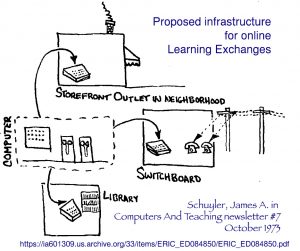 In the 1970s, as a part of my Computers And Teaching [CAT] project, I had a lot of conversations about how computers might transform learning, communication, and social interactions.
I’ve already remarked on some predictions I made in 1973, including working from home, email, co-working spaces and online community access to information and learning. There were a lot of people working on these concepts in the 1970s. Many people had these and similar ideas, and much of the work presaged today’s online educational and social media. My personal focus was on communication in education, and my work involved using a supercomputer (and later a minicomputer) as a hub for education and distance-independent group communication.
Notable among those I interacted with
Community computing—People’s Computing Company (Bob Albrecht) in Menlo Park. Resource One (Lee Felsenstein) on Howard in San Francisco. Whole Earth Store (Rich Green) in Evanston (and Berkeley).
Computer conferencing—Murray Turoff (New Jersey Institute of Technology and formerly the Office of Emergency Preparedness). NSF project managers.
Networks—Doug Engelbart and team (Stanford Research Institute, SRI). I was at Doug’s lab he day they connected to the “Arpanet.”
(There’s a whole additional thread of people who worked in computer-based-education, which I’ll write up later.)
Resource One
[from PDF Online Computer Conference 1973 ]
This is Lee Felsenstein of Resource One speaking. This is our first attempt at using the ORACLE system (What did that OK mean?). We will be participating using our XD3-940 timesharing system. We hope to make the conference A) (IND of sub-conference here, since we will be able to accommodate several people building comment files on our editor program and shipping these comments off post-haste during our connect time. Likewise we will be able to accumulate files of comments from Evanston and will print these upon our high-speed printers so that participants here may read and absorb at less than 30CPS. We are inviting several people from alternative education circles. We also hope to stir up enough interest in local people so that they will be interested in starting a Bay Area learning exchange, hopefully using our machine and its information-retrieval system (ROGIRS). We have been operating a version of this system as a public-access database in a record store lobby in Berkeley for over a hundred days, letting just plain folks come up and use it like an electronic bulletin board. It works! People smile as they are told that it’s a computer at their service, we have accumulated about 700 items on the database so far (Items expire too, so there’ve been many more entered in toto).
You search for your item by telling the computer to find all items satisfying a particular combination of keywords which you specify. Keywords are determined solely by the person who enters an item and can be any string of characters. The terminal tells the user how many items have turned up satisfying a given keyword set. Example FIND RIDE EAST (Note: ‘and’ is implied by no connecting word between keywords);
13 ITEMS FOUND (This is the response from the machine). AND NEW YORK OR NY (this is the user narrowing these – actually a mistake has been made here, the machine will add to the list of items having keywords RIDE, EAST, NEW, YORK, the sum the items having keyword NY, anyhow enough detail). The user types ‘PRINTALL’ or ‘PRINT:’ if they want to seal off the found items or just the first one respectively. The user may add an item at any time. There is no preset field structure or limited set of keywords the system can print. An alphabetized list of keywords currently in use at any time. This list is kept by the Berkeley terminal. We think that this system can be used as is for filing in a learning exchange. It is important to note that the system makes no judgements, but is simply a very talented file clerk that doesn’t keep you waiting. We are ready to offer terminals into system to local users who can participate in paying our costs. (We are nonprofit, the machine and a startup grant were donations, but operating money is not assured.)
We will be refining the information retrieval system and hope to be able to move it off future (equipment costs $50,010 for system serving 64 simultaneous users and capable of storing several million items XXX whoops, that would be about 100-200,000 items at 200 average characters per item) and will be eager and able to manufacture such systems which require no daily maintenance. Why not have everything?
Our address is 1380 Howard St., San Francisco CA, 94103, and our phone is xxxxx. Off for now.
Schuyler comments about online conferencing
…Perhaps you know that this conferencing program is a part of a computer-aided-instruction system, though it could be used in any general-purpose time-sharing system. The PLATO-IV system, with about 200 to 300 terminals now connected also has some conferencing programs like this — one (called TALKOMATIC) is for simultaneous participation (synchronous conferencing) and another (called DISCUSS) is for asynchronous conferencing (storing its comments as it goes). These make it possible for sites like Northwestern (180 miles from Urbana) to converse freely with people at other PLATO sites, without going through the hassle of a long-distance phone call. They are extremely useful! Thus, conferencing is already an important part of the largest C.A.I. system built to date!
Karl Zinn – CRLT Ann Arbor, Michigan
I like the idea of on line conferencing, or in general, teleconferencing. Potentially it brings people together at less expense, and leaves a trace of interaction, and the interim storage of messages and comments can aid interaction when two personal schedules do not match. I hope such conference activity also will bring about more thoughtful statement of ideas and more careful criticism. However, the computer programs should do much to aid in this. For example, within this conference file, or another file could I list an agenda or set of issues (without listing all proceeding entries)? Can I list all current or previous participants? Can I search previous entries by participant, keyword or content (as well as date)? Can 2 or more participants work on a common statement and so on. Perhaps much can be learned from experiences with the PLATO system and with Engelbart’s system at SRI…
Construction Crane Mania
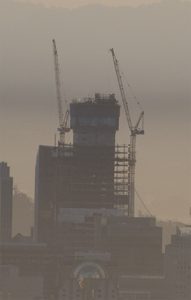 You may guess from my article about the new Salesforce Tower that I have been fascinated by construction cranes for some years. Believe it or not, it was only about three years ago that I looked into how those tall cranes manage to get taller as their buildings grow into the sky. Obviously something happens, but I hadn’t ever figured out the details.
Of course, millions of other people have also found this fascinating, and the companies that make those cranes have provided us with the critical info on how the cranes work.
It all goes hand-in-hand with the process of building these skyscrapers. Salesforce Tower, like many other tall buildings, has a concrete core that goes up a few floors at a time, with a steel exoskeleton that follows a few floors behind.
To lift those steel beams requires a construction crane on a tower, and that tower must get taller as the building gets taller.
For Salesforce Tower, there were two tower cranes that started at perhaps 100 feet tall, and then grew around 100 feet each time the building’s concrete core caught up with them. As the building topped out, they were nearly 200 feet above the 1,070 foot structure.
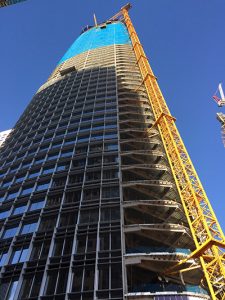
The growth of the building’s core and the two cranes can be followed easily in the time-lapse provided by the building’s team. (see the little Play time-lapse sequence button  in the control strip below the visual player on that page) You’ll see the concrete core rise, clad in blue protective sheathing, and the steel follow behind it, with the two yellow tower cranes staying ahead of this progress by a comfortable distance.
Salesforce Tower completion
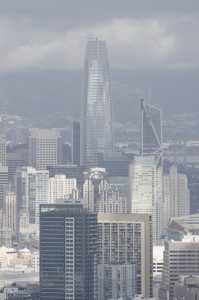 The new Salesforce Tower, in San Francisco, was a not-so-deep hole in the SoMa ground a little over two years ago. Now it’s completely topped out and at night some floors have lights in them. The six or so floors at the very top are also now lit at night. Don’t think there are any residents yet, but certainly soon.
I have really loved being able to watch this project, from just a few miles away, and to be able to walk past the site almost weekly, observing how it has progressed. There’s a great time-lapse sequence, as well as selection of photos by date, on the Salesforce Tower web site.
This photo gives a fairly surrealistic view from near Twin Peaks, which is centrally located in the San Francisco landmass about three miles from the tower.
The building makes its own weather at its 1,070 foot height, disrupting most airflow that has come in through the Golden Gate just a few miles to its west, making its own clouds both in front of and behind the structure.
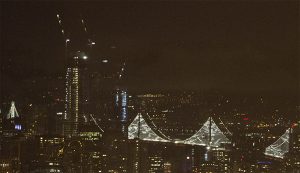
During construction, you could see work continuing well into the night — evidenced by two giant construction cranes at the top of the building with their red lights moving from side to side as beams were hoist into place. In this nighttime photo, you see three lighted spans of the (old) Bay Bridge on the right, then a second tower (blue lights), then the yellowish vertical lights of the Salesforce Tower, with two construction cranes at the top.The cranes and their towers were removed early in 2017.
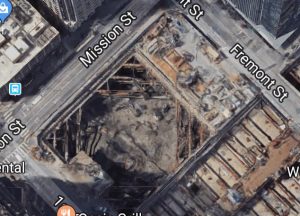 The Google Maps satellite view today (2017-12-18) still shows the site as it appeared before construction of the vertical structure had begun, approximately August of 2015.
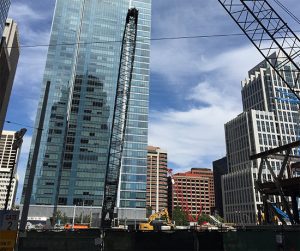
Below here’s my photo of the site before that time with a yellow concrete rig and other cranes on the still-flat earth of the site before excavation, but after piles had been driven deep into the ground. Behind it on the right in the photo is the steel frame of the Trans-Bay Terminal, a multi-block-long terminus for busses coming from the East Bay and North Bay. That’s a completely other story, with deep excavations and long caverns destined to hold busses and eventually high-speed trains to and from central and southern California.
During construction we could view the building rising floor by floor around its concrete and steel core over the nearly two years of above-ground work from including most of 2016 and all of 2017. This pre-dawn photo is from May, 2016.
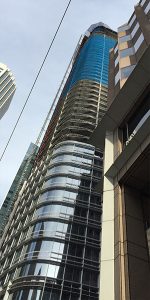
As the building grew, it was enclosed in blue protective mesh to keep debris in, and windows were lifted, one by one, on the giant construction cranes, and swung into place on every window of every floor. This took place day and night, weekends included, month after month (Photo from November, 2016 before the building had even topped out.)
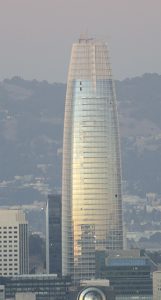
When the glass exterior was completed, the building began to shine with reflections of bright sunsets, reflecting the rainbow hues from light blue above, down to reds and the yellow-red of the setting sun. The building takes on this set of rainbow hues at sunset and dusk most clear days. On other days, it may remain silvery grey, yet highly reflective, all day long.
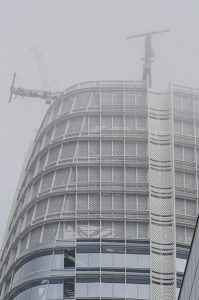 How do they keep all this glass clean? Yet another story to be told later. My last photo, here, gives you a hint of how they will be doing it. The two devices at the top remind me of window-washing rigs.
Computing Comes to the University
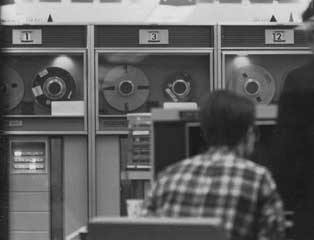 Chapter 1 of 7 in the DesignWare history thread.
In thinking back about how I came to the decision to form DesignWare, I have to acknowledge some important roots. When I’m coaching people these days, I always ask them to describe for me their core capabilities — those capabilities or interests that keep coming back into their lives.
- « Previous Page
- 1
- 2
- 3
- 4
- 5
- 6
- …
- 46
- Next Page »