Tag: social behavior
Twitter made me (not) do it
by Sky on Sep.07, 2008, under Blogging, Cyber-nomads, Our networked world, People, Software and online tools, Technology and geeky stuff
It’s been a whole month since I wrote anything in my blog? What happened? (Or rather, what did not happen?)
Well, let’s just blame it on Twitter. Or on the new iPhone. Or on two clients wanting 70-hour weeks from me all month. Or on processing 4 hours of teacher training videos.
Nah, let’s just blame it on Twitter.
Twitter seems to have taken a big bite out of my blogging energy lately.
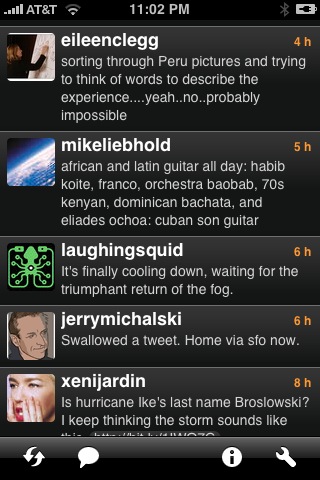
I primarily use Twitteriffic on my iPhone to both follow and to create new tweets, but I also love Twitterfox (a plug-in for the FIreFox browser) if I’m at a computer (it just pops up a little panel showing the most recents, and lets me quickly twipe a new tweet whenever I feel the need.
But why do I even bother with Twitter? – because I get stoked with a dozen new ideas every day! In the old days, “kids” used Twitter to vacuously and narcissistically communicate “I’m having breakfast” or “I’m on the bus” or “I’m at the coffee shop.” But somehow a large number of busy people realized that not only was this a waste of a good communication medium, but something better could actually be done with it – and now what we do is communicate concepts, places, activities and ideas of interest to our group. Someone might be experiencing writer’s block and need inspiration and put out a call for help that explains the concept she’s working on, and get back a half dozen interesting tangential ideas! Another might have returned from a trip and posted photos – and will put up a tweet pointing to the photos. Someone else will be at a conference and will tweet about each speaker’s primary concept.
You have to carefully pick who you “follow” (whose tweets you subscribe to) on Twitter, but once you have your list tuned well, you have constructed a channel that lets you really stay in touch with the ideas and activities that will surface as blog posts and news in the next 24 to 48 hours. And you get a real boost from knowing what your friends and colleagues are working on and thinking about.
Let’s be Clear About This – Lots more Laptops will be Stolen
by Sky on Aug.05, 2008, under Identity & The End of Privacy, Security
The Clear program at San Francisco International Airport (SFO) has suffered an almost-predictable blow – a stolen laptop computer containing confidential records.

Clear is the program that pre-screens travelers, collects biometric data, puts this on a smart-card (embedded processor+memory, not RFID) and then allows travelers at a few high-traffic airports to go thru a quick-screen line (including a retinal scan to verify ID) rather than stand in lines with un-pre-screened passengers. They still get screened, but they “jump line,” sometimes skipping ahead of a hundred or more who are waiting in the regular lines.
Almost predictably, a laptop containing the data of 33,000 applicants (not participants) was stolen from a secured room at SFO. A spokesperson says “it [the laptop] was protected by two passwords” – but that doesn’t tell us whether the information was encrypted, how secure the encryption was, nor why sensitive information would be on a computer that is portable (and thus easy to steal) computer. (It is pretty easy to bypass password security unless the data is also encrypted – I’ve done it myself more than once on client computers where they’ve forgotted a password – takes about 10 minutes.) And we don’t know what other types of information might be on this computer.
Clear is run by an independent contractor under TSA oversight.
One interesting outcome was the comments ABC7 (San Francisco TV) collected – for instance “Clear customers say the sooner the changes are made the better, although no one seemed too worried about the security breach. ‘You’re information is everywhere and people volunteer their information on places like Facebook, on Twitter, on MySpace and stuff,’ … a traveler.” I don’t actually think they understand the breadth of information that was reported to be on that computer – this is information that is to be used in a security screening, not just social security numbers (though those may not have been present), and presumably known only to the applicant – a far broader range of confidential information than most other systems would hold. It just shows that people are resigned to living in a transparent world – probably until they are directly affected, of course.
KTVU reportage on this same story. KTVU also reports “The TSA requires RT service providers and sponsoring entities to encrypt all files containing participants’ sensitive personal information. Noncompliance with such requirements can result in actions including suspension of a program and possible civil penalties.” I have not verified this, and we don’t know the type of encryption that’s required – for instance a password on a ZIP file is probably not very secure, while encryption with a 2048-bit RSA key would be a lot harder to crack.
I earlier reported on “odd” scanning of my driver’s license at a regional airport, to which TSA replied (in comments on my blog) that it was (probably) an ultraviolet light (blacklight) being passed over the license to be sure it was genuine (this process reveals the “holographic” images in the license’s plastic layers). As I said, I was concerned that any scanned information that passed into a laptop computer allowed potential theft of this confidential information. Well, I guess this Clear incident further emphasizes that security information has no business being stored on a computer that can be physically stolen.
Bye Bye SMS
by Sky on Aug.01, 2008, under Pervasive gaming, Technology and geeky stuff
My real-world mixed-reality games were originally built to depend primarily on SMS (AKA “TXT” in the US) messaging. As the years went on (I started this in 2002) I found that I had to develop the games further so they could be played by email. As they became more location-independent, playing by email made more sense, and people really wanted to play by regular email rather than just on phones.
Then came the iPhone. And rich (HTML) email entered the picture for mobile devices. And richer and longer in-game responses from players. (SMS is only 160 characters, while email doesn’t have this limit, and thus is so much more fun.)
Well, over time that changed. Sometimes text messages are delayed for a substantial time (can tale hours), and our games are real-time so any delay beyond say one minute is a catastrophe. And then more and more phones became capable of sending text messages to email addresses – it had only been T-Mobile at first, and now it’s most phones. Today, at least 50% of phones in the US are capable of sending/receiving email, even thru the SMS mechanisms (there is an SMS-to-email interface on all systems).
So we’ve made a number of improvements in our games that permit play from regular email as well as mobile email-capable devices like phones, PDAs and smartphones.
And it looks like 2008 may be the year that we’ll develop more of these new, rich street games based on HTML email, and still played from mobile devices like the iPhone.
Yesterday (July 31st) we sat down and planned the trajectory for the next few such experience for YBCA – this is going to be fun. Watch for more on this as we announce the next YBCA game (October).
Access Denied – Which Countries Filter and Why?
by Sky on Jul.22, 2008, under Blogging, Human Rights, Media
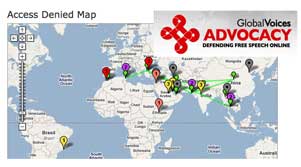
·GlobalVoices ADVOCACY has a page they call the Access Denied Map. On it they track visually, including pop-up annotations, countries that prohibit access to web sites.
The thing that made the biggest impression on me is the number of countries that block bloggers or Flickr. (You can check this yourself by going to their site and clicking the pushpins on their Google map.) |
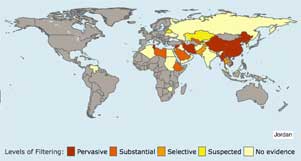
·Opennet.net also tracks blocking/filtering worldwide. They look at the reasons given for filtering and compile maps tracking four different types of filtering.
|


I hope you'll enjoy this mix of topics stemming from my ongoing experiences in the world of online communication. Oh, and sometimes the inspiration comes from face-to-face communications too. Many are sparked by my work as Chief Technology Officer of