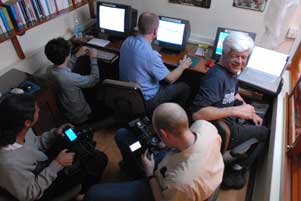
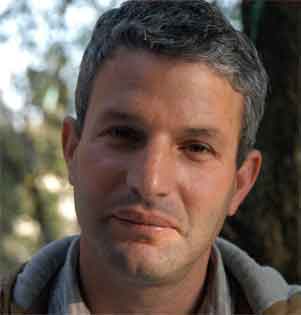
 I interviewed John Sorensen, producer for the Project Happiness documentary, asking him what happens behind the camera and then after all of the video has been shot.
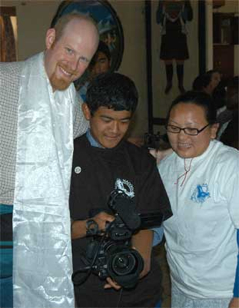
[In the photo you see John, Tenzin Dawa (the TCV cameraman mentioned in the audio clip), and Yeshi Khando, the teacher who picked up this project and ran with it at Upper TCV.]
John’s team of professional collaborators, David Goulding who handles the “big” camera, and Brian Buckley, who captures the sound while they’re shooting, are also interviewed in our series.
This is a challenging process, with video captured in several formats, several shoots in the field, and diverse cultures with different familiarity with the technology.
| Play the interview: |
Listen as John describes the process of making the documentary, shooting in California, Nigeria and India, and how the team works to create the raw footage that then goes to the “cutting room” where it turns into a final documentary. John speaks with knowledge, insight, and deep feeling about the process.
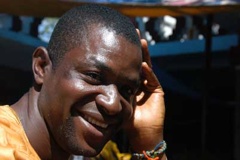 This is a “cafeteria interview*” of Emmanuel Ande Ivorgba, conducted in New Delhi on Friday, the 30th of March, 2007 at the YWCA. Beginning in 2005, after encountering The Dalai Lama Foundation on the world wide web, Emmanuel began a study circle for adults. This expanded into 14 adult circles and 25 students circles, and centered around 8 schools in Jos, Nigeria.
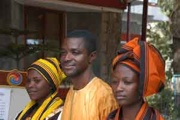 Private schools play an important part in education in Nigeria. Public schools cannot handle the entire load, and students frequently begin school at a late age, so private schools have stepped in to carry part of the load. Students are encouraged to stay in school until they graduate and sometimes do not graduate until as late as the age of 23. (The photo shows Faith, Emmanuel and Mercy at Chonor House in Dharamsala.)