 The Electronic Frontier Foundation [EFF.ORG] has a “patent busting” activity that watches for patents that “should never have been granted” (my language) and works to invalidate them, or at least invalidate as many of their claims as possible.[1] You’d be amazed at the kinds of things that have been patented that were just plain obvious, or had clearly been invented years before by someone else. I’m particularly sensitive to this because of my long history in computer-based learning and education. As an example, EFF is focusing on busting a patent on online test-taking. This one hinges on a method for charging for the tests and splitting the revenue, but nevertheless it seems absurd that someone could obtain a patent on splitting revenues from test-taking, doesn’t it?
[1] A patent hinges on any number of “claims” which are generally separate and somewhat independent of each other, and these are usually structured in such a way that they’re like ”gotchas” — if the patent owner can’t get you on one of them he may get you on another of them. There is a tension between how much is claimed by the inventor and what claims the patent office allows — and this back-and-forth starts at the time a patent application is filed, continuing until the patent is either issued, claims are removed, or the application is denied. On a granted patent, its strength is generally related to how many claims there are and how broadly they can be applied to a competing invention. Attacking a patent involves showing that individual claims should be invalidated, until you have either stricken the entire patent or reduced it to a few claims that are so weak it can no longer be effectively used.
 The free flow of information, which is facilitated by the Internet, should have no respect for political borders. Nations that try to restrict the flow of information by either cutting it off at the border (using Internet routers and filtering) or by cutting it off in the “last mile” to your computer (using content filtering and throttling [see
  Craig Newmark put up
  Please stay aware of this issue – network neutrality means that you, the Internet user, have access to all online content with the same priority. It means that the carriers — both those who provide backbone services and those who deliver content to your doorstep — must not block certain types, or certain origins, of content that is lawfully provided to you.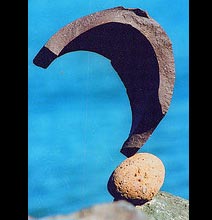
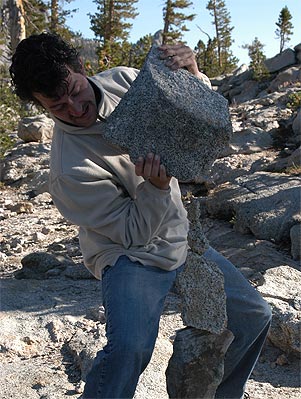 Bill’s work inspired Aaron [in the photo, 2005] and me (a few years ago) to create some balanced-rock sculptures in the High Sierras. This was a ton of fun!
 It surprised me that I could build sculptures that would hold up even in the face of strong winds. I left a couple of these towers standing while I went away on a day hike and they were still there when I returned. Lots of fun – try it yourself.