 I like OpenID[1] although I think it’s more complex than most people can handle — and that’s a big hurdle. OpenID gives visitors to your blog or web site a chance to log in (create an account on your site) using their login information from a participating OpenID web site (like gmail). In other words, they don’t have to create a separate account at your blog – they just reuse their Yahoo (or gmail or other[2]) account. In theory this should make it easier to remember account names and passwords because you just use one account to log in at many sites.Ever since OpenID was announced (2005) I’ve loved the idea. There are OpenID providers, and then there are other sites that allow users to utilize OpenID for the creation of accounts.
I’ve lost my identity- would you please look under the couch?
 Where’s my identity? Well, of course, it’s my brain and body, to be sure, and all of that stuff I’ve done during my lifetime, and all the connections I’ve made, but then again, my personal data is all over the place so who knows how much of me might be scattered around in many places?
The thought occurred because I got out of my car a few weeks ago without turning it off, and when I returned to it several hours later, it was still on.[1] Nobody had messed with it, but it had remained there at the curb completely “on” and drivable. My “identity” as far as the car was concerned was the RFID “key” that I was carrying with me.
Where else have we embedded or attached our identities to physical objects these days? [Read more…]
Where are your Twitter followers?
 Robert Scoble just posed this question, “Someone just asked me if there’s a good way to get a holistic look at Twitter or friendfeed followers. I don’t know of any. Do you?”
He was talking about their geographical locations. Among the answers, one person pointed at a Yahoo Pipes application that puts pins (each corresponding to one follower) onto a world map. I‘ve written about Yahoo Pipes before — it’s a web service that lets you “visually” create an algorithm that reads RSS feeds and manipulates them. Pipes can filter, put together, count, limit and obviously do a lot more. I have created a Pipes application that filters several RSS feeds and then makes them available for insertion on a blog.
The Solar Outhouse
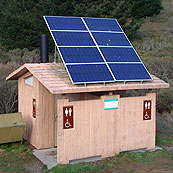 Solar cells on an outhouse? Yup. In the coastal headlands of Marin County.
We see these in the Sierras (the mountains) as well, in some high-traffic publicly-accessible areas of the wilderness. Usually the solar cells in the mountains are powering fans that circulate air into a composting toilet (one that composts the deposits rather than requiring removal to another location). And they’re generally so far from civilization that running a power line would be ludicrous.
But it always seems funny to me.
Earthquake Measurement Online
 This is more fun than any sporting event. The US Geological Survey long ago automated their earthquake reporting instruments and it has become somewhat of a sport to see how fast we can report the shaking intensity and other details following even the smallest seismic event. There was a small quake near AlumRock/San Jose/Morgan Hill about an hour ago and a couple thousand people went to a USGS web site to report the intensity – as they felt it – with many reports coming in within 10 minutes of the actual event (and 14,000 reports in an hour for this particular one).
Read more about what the USGS has available online for earthquake reporting. [Read more…]