 In early June, I was in a nice rainy East Coast US city for meetings dealing with particularly thorny issues related to ways the Internet experience is being killed off for regular folks—and for institutions (NGOs) that are promoting free speech and human rights. Over a small breakfast, I sketched in my book some notes about the progression of malware over time. Basically paralleling the development I describe in my site The Social Graph of Malware, malware has gone from simple and juvenile defacement of web sites to become sophisticated and bandwidth-hogging socially-engineered schemes designed to get people to fall for a purchase they didn’t want to make, or just to click a link to enroll their computer in a network of zombies poised to conduct nasty attacks on other people. [Read more…]
The iPhone is an “amateur radio”
 Comeon‘ Apple — we all know “my phone has five bars and yet it drops calls all the time.” I call customer support on average once a month about this. They have even given me credits on my bill (not often). They have told me to download and use their app AT&T Mark the Spot to report poor-reception areas. Which I do routinely.
Now that Apple has announced that the reception measurement on the iPhone is incorrect (reading too high by about 2 bars in some cases), I no longer have an excuse. AT&T claims to have 10 towers within a 2-mile radius of my home office, but most of the time 2 or 3 of them are ”down” and besides, in San Francisco, over half of them are “behind a hill” from me so they do me no good. There are probably only 2 or 3 towers that actually give me any coverage in the office here.
But, Apple knew about the +2 bars problem a long time ago. It was reported in 2009. We were all seeing 2 or 3 bars, and then our software was upgraded and we were seeing 5 bars routinely (except when there were none). We customers knew that the iPhone was giving us more bars than it should have. So why did Apple not know this, or not see the change when this happened in the first place?
And Apple was surprised about this?
Any mobile phone is a mobile radio. And amateur radio operators, which we all are these days, know that if you touch (and thus “ground”) the antenna, you cause a change in signal strength.
Joi Ito on Innovation and Startups
I love Joi Ito’s advice about startups. Mostly he is talking about understanding risk. I particularly focused on one section just after 9 minutes into the video where he talks about how it’s folly to spend a lot of time building a business plan when it’s so inexpensive to go ahead and develop your product iteratively and develop the plan after you’ve seen how your customers are reacting to the product. Here’s the video:
[vimeo 6827318]
Pad Computing in Sci-Fi and in Real Life
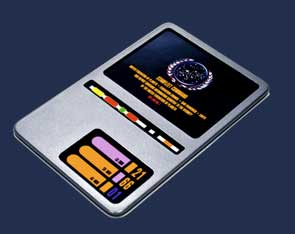 The iPad immediately led me to think about how tablet computing is portrayed in science fiction. TV and movies – because that’s the only place you actually saw little beasties like these 10 or 20 years ago.[1] Today they’re (literally today) all around the world.[2]
 In Sci-Fi Channel’s series Caprica, portable computing has become “foldable” and takes the form of sheets of “paper” on which characters, symbols and other stuff light up so you can read them. The paper is touch-sensitive and you can move the characters around as well as tap them (read “keyboard”). [Read more…]
Secret courts, secret orders
 Cory Doctorow posted a BoingBoing article about a recent National Security Letter requiring the Internet Archive to reveal user information to the FBI. In case you’re not familiar with this process, certain government agencies can issue these letters under the PATRIOT act, which require you to disclose information about your online users, and you can be required not to disclose even the existence of the NSL to anyone else – not your board of directors, not your employees, not even your dog. You can tell your attorney, otherwise this would violate due process of law because you would be denied legal representation. EFF stepped into this[1] as legal adviser to the Internet Archive and Brewster Kahle. The legal grounds on which they contested this was that the Internet Archive is a library (recognized by the State of California) which is exempt from these requirements under US law. The provisions apply to providers of Internet communication services (such as ISPs, duh, by definition).
Regardless of how you feel about government agencies having unchecked access to this kind of information — If you ran an online service that promised “we never share your information with anyone else” – what would your reaction be to an NSL requiring that you give up something like IP addresses, or physical address, or other information about a user of your service, without informing anyone? Would you be happy telling your users that you never share their information?
- « Previous Page
- 1
- …
- 26
- 27
- 28
- 29
- 30
- …
- 91
- Next Page »